
From Pilots to P&L
Why AI-Fluent Business Leaders Are More Likely to Outgrow Their Peers
By Prashant Arora
Transformation-focused IT executive helping enterprises turn operations into AI-enabled business capabilities | CPG, Manufacturing, Healthcare
In various conversations across senior leaders in CPG, manufacturing, and healthcare on enterprise transformation, one question comes up repeatedly: “Is AI fluency for business leaders truly critical, or just another tech hype cycle?”
Over the weekend I have researched various reports to cut through the noise with evidence from Harvard, MIT Sloan, Deloitte, McKinsey, BCG, Gartner, and the World Economic Forum. The answer? AI fluency isn’t the only must-have skill for business leaders, but it’s now non-negotiable. One of a tiny handful that separates high-performers from the pack.
Here’s the evidence, the nuance, and 10 practical actions to move from AI experimentation to business impact.
The Data Business Leaders Need to See
Most companies experiment with AI. Very few turn it into sustained advantage. The research reveals consistent patterns:
- 74% struggle to scale beyond pilots. Leaders who focus on 2-3 high-value use cases expect 2x the financial returns (BCG).
- AI-led organizations achieve 2.5x higher revenue growth and superior productivity (Accenture).
- CEOs call AI foundational to their future, but only 44% consider their CIOs “AI-savvy”, fewer trust other C-suite roles (Gartner).
- Harvard and MIT now offer dedicated programs teaching P&L owners to identify value, redesign workflows, and manage risks, not build models.
- The World Economic Forum insists C-suite leaders must own AI strategy, ethics, and governance.
“AI isn’t replacing leadership. It’s raising the bar. Human skills like – judgment, creativity, ethical thinking, change leadership, remain essential. But AI fluency lets leaders navigate AI-generated insights, new operating models, algorithmic risks, and human-AI collaboration at scale.”
Why This Hits Harder in Your Industry
CPG: AI transforms demand sensing, trade promotion, and personalized loyalty.
Manufacturing: Predictive maintenance and quality control reshape plant economics.
Healthcare: Clinical optimization and resource allocation directly impact outcomes.
Retail: Dynamic pricing and assortment become competitive weapons.
These aren’t IT projects. They’re P&L decisions requiring business leaders who understand AI’s real potential and limits.
The Bottom Line
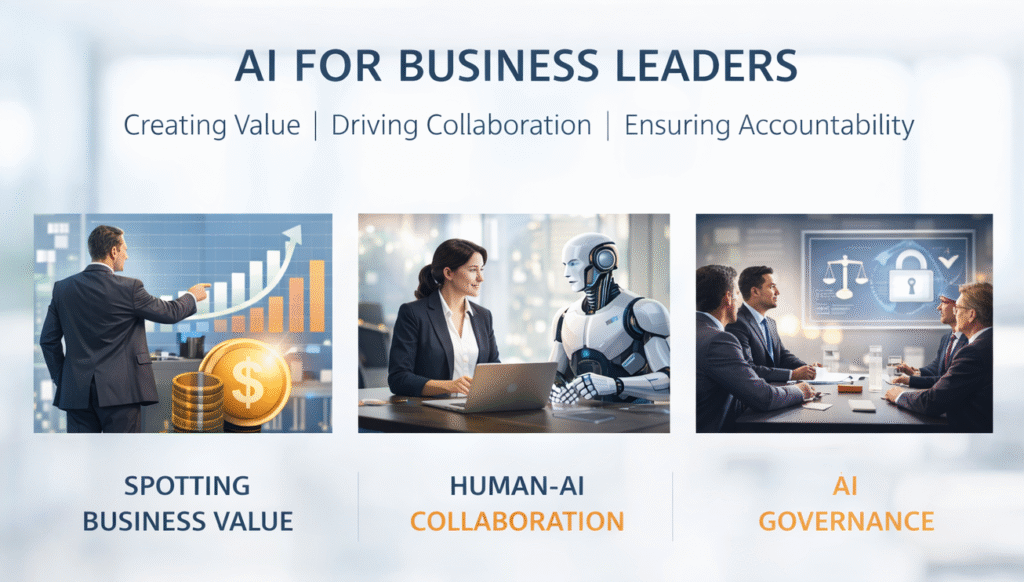
AI for business leaders means three things:
- Spotting where AI creates measurable business value
- Redesigning operations around human-AI collaboration
- Governing AI responsibly at the leadership level
Think of it as a new pillar of leadership alongside strategy, finance, and people, amplifying them all.
Your 10 Actions to Lead AI Transformation
These are prioritized for immediate impact. Focus on 1-5 in the next quarter.
- Benchmark your AI fluency against Leadership / C-suite standards (you don’t need to code, but you must understand value creation via AI)
- Map your top 3 high-ROI AI opportunities directly to P&L levers (your ‘Big Bold Bets’)
- Redesign one core workflow for human-AI teaming (start with demand planning, S&OP, or service operations)
- Establish AI governance with clear accountability and C-level oversight (preferably a community of practice including tech, legal, control & audit etc.)
- Build strategic AI fluency across your leadership team through targeted executive development programs (there are plenty from top institutions)
- Kill pilots without clear ROI, measure every AI initiative by business KPIs (no more pilot purgatory)
- Upskill your leadership team through sector-specific AI training (AI could mean different for CPG vs. a highly regulated Healthcare, different for US vs. Europe)
- Align AI investments with financial discipline and risk frameworks (relentlessly prioritize AI investments. It’s powerful, but not cheap)
- Foster safe AI experimentation, psychological safety drives adoption (innovation needs room to fail while education and enablement drive adoption)
- Eliminate AI silos build cross-functional ownership across functions (it’s a team sport, you need connected workflows)
The Strategic Imperative
The organizations pulling ahead aren’t building the most advanced models. They’re led by executives who turn AI into business outcomes. In CPG, that’s accurate demand forecasts. In manufacturing, zero unplanned downtime. In healthcare, optimized care pathways. Without AI-fluent business leadership, these remain expensive experiments.
Remember: Leaders who master this capability don’t just adopt AI. They transform their enterprises.
If this resonates, share it with a fellow leader navigating AI transformation.
What’s your single biggest AI priority this year? I’d value your perspective in the comments.
*Based on comprehensive analysis of Harvard, MIT Sloan, McKinsey, BCG, Deloitte, Accenture, Gartner, and World Economic Forum research on AI leadership capabilities.