
For years, enterprises have been on a relentless pursuit of visibility. Organizations invested heavily in dashboards, analytics platforms, operational reporting, and more recently, AI copilots, all with the expectation that more visibility would naturally translate into better decision-making.
Yet despite this progress, many enterprises continue to struggle with the same underlying problem: they possess more information than ever before, but not necessarily more intelligence. Operational teams are inundated with signals, executives face competing narratives from fragmented systems, and organizations still spend disproportionate amounts of time reacting to issues rather than anticipating them.
This, in many ways, is the central challenge facing modern enterprises.
Having more data does not automatically make an organization smarter. In fact, in many cases, it creates a new kind of complexity.
A dashboard may indicate one trend, while a ticketing platform reveals another. Employee experience metrics may surface friction long before traditional KPIs recognize any degradation. Vendors often interpret performance differently from internal teams. Signals exist everywhere, but context remains fragmented.
The result is a familiar organizational reality: enterprises spend too much time trying to understand what happened instead of shaping what happens next.
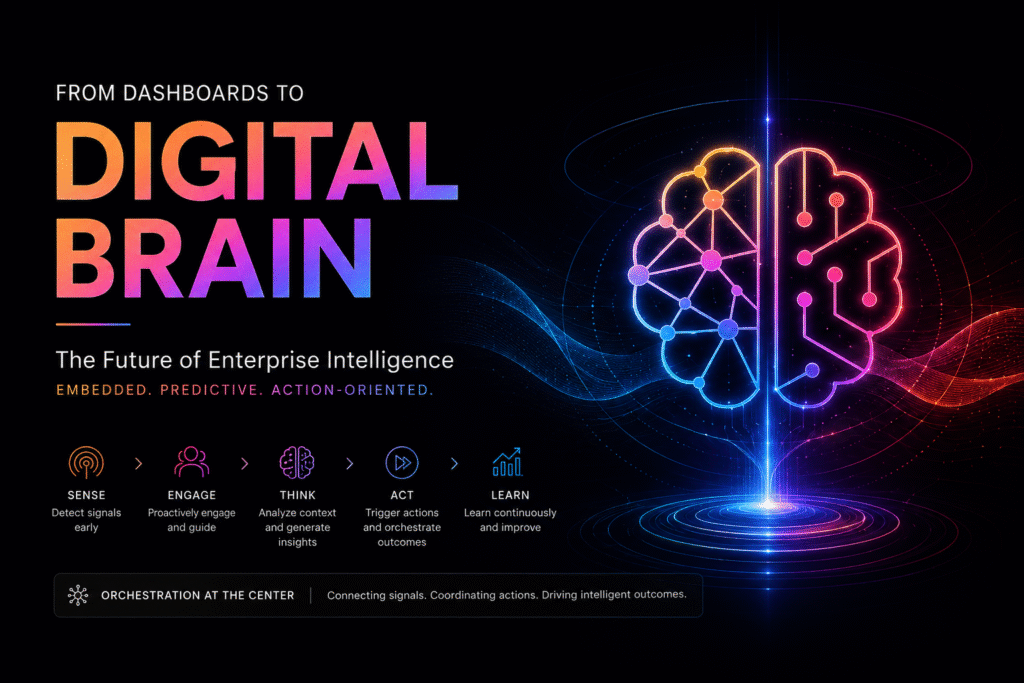
I believe this is where the next chapter of enterprise transformation begins, not with better dashboards, but with something fundamentally different: a Digital Brain.
The Enterprise Problem We Don’t Talk About Enough
Most enterprises today continue to operate on what can best be described as a delayed response model.
A disruption occurs. Signals begin to surface. Teams investigate. Meetings are scheduled. Data is analyzed. Accountability is clarified. Decisions are eventually made, and actions follow.
The challenge is not that organizations lack competence or capability. The challenge is timing.
By the time enterprises fully understand what is happening, the business has often already absorbed the impact. A technical outage may have escalated into widespread productivity loss. Employee frustration may already be affecting adoption or engagement. Supplier issues may have cascaded into broader operational disruption. Customer experience may have deteriorated before intervention becomes possible.
This is not merely a technology problem. It is a decision latency problem.
Modern enterprises generate an extraordinary volume of operational signals, far more than humans alone can realistically process with sufficient speed or contextual understanding. As enterprises scale across hundreds of applications, thousands of workflows, distributed teams, complex vendor ecosystems, and millions of daily interactions, traditional operating models increasingly struggle to keep pace.
For years, organizations optimized for visibility under a simple assumption: if we can see more, we can manage better.
That assumption worked in environments with lower complexity and slower rates of change.
Today, however, visibility alone is no longer sufficient.
The challenge facing enterprise leaders is no longer access to information. It is the ability to convert fragmented signals into connected intelligence, quickly enough to influence outcomes.
The Original Thinking Behind Digital Brain
Across my experience leading large-scale transformation initiatives in global enterprises, one recurring question continued to surface:
What if the enterprise could sense problems earlier, think smarter, act faster, and continuously learn?
Not through another reporting layer. Not through another dashboard. But through an intelligence layer embedded directly into the flow of work.
That question ultimately shaped the thinking behind what I call the Digital Brain.
At its core, Digital Brain was never conceived as a replacement for human judgment. The objective was not automation for automation’s sake. Rather, the ambition was to augment enterprise cognition, enabling organizations to make better decisions, faster, and with richer contextual understanding.
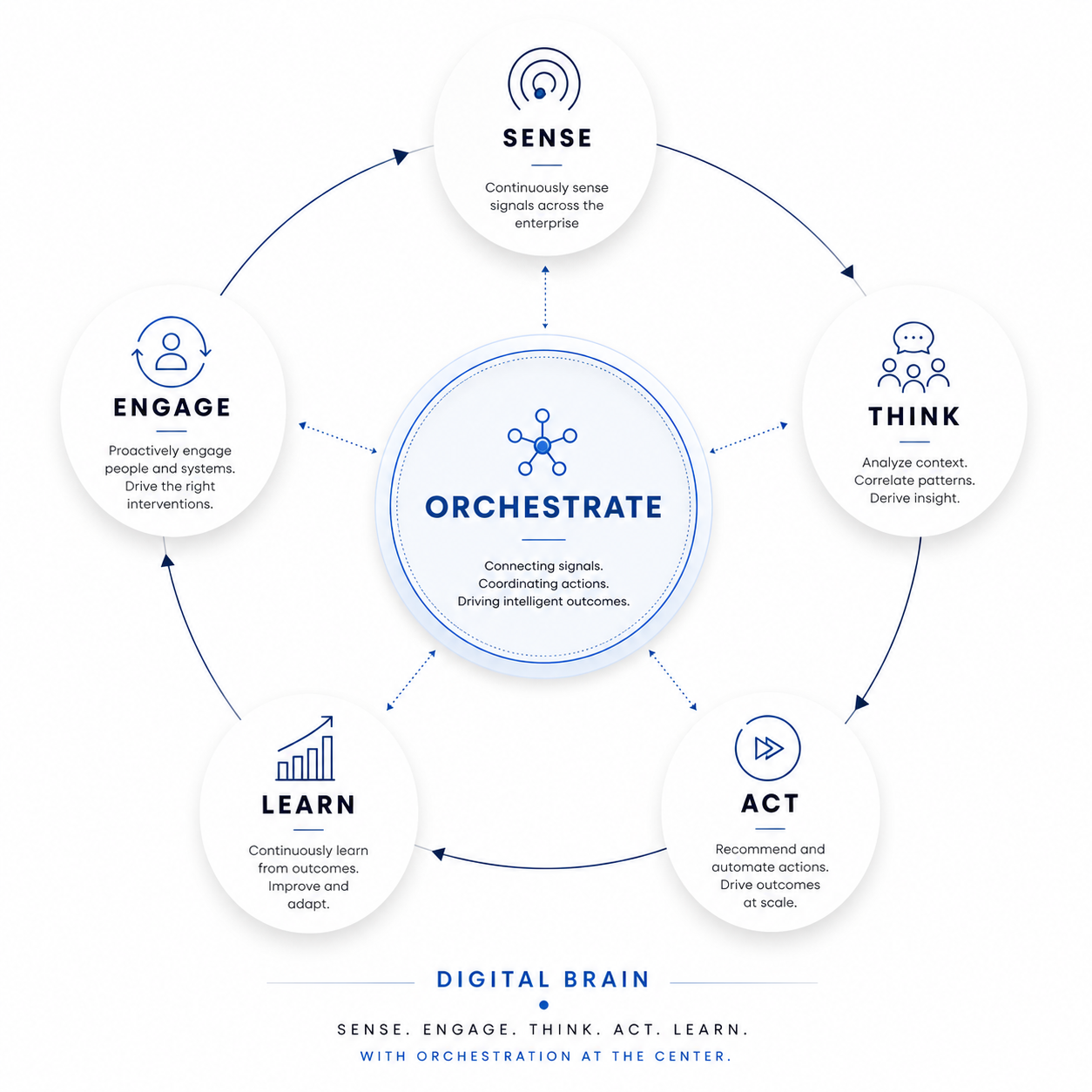
The concept rests on five interconnected capabilities: Sense, Engage, Think, Act, and Learn, with orchestration serving as the connective tissue across the model.
Sense: Listening to Enterprise Signals Earlier
Every enterprise continuously emits signals.
The issue is not a lack of information but the inability to recognize weak signals before they become visible disruptions.
Digital Brain begins with sensing, continuously gathering intelligence across operational systems, employee interactions, service experiences, workflow patterns, vendor ecosystems, incident histories, productivity indicators, and business applications.
The premise is straightforward but powerful: problems rarely emerge without warning.
Operational disruptions, employee friction, service degradation, and productivity bottlenecks typically leave signals long before they become visible at scale. The challenge for most enterprises is that these signals often remain disconnected, hidden inside isolated systems, or ignored until escalation forces attention.
In many ways, enterprises do not need more data. They need to become better listeners.
Engage: Moving Beyond Observation
Traditional enterprise systems often stop at visibility.
A dashboard informs leaders that something has happened, but responsibility for interpretation and action largely remains manual.
Digital Brain extends beyond observation into engagement.
Instead of simply surfacing information, it proactively interacts with the enterprise. This could involve nudging teams before issues escalate, triggering workflows, surfacing recommendations, enabling copilots to guide employees, or proactively resolving friction before productivity suffers.
This distinction matters.
Intelligence without engagement remains passive. Observation alone rarely changes outcomes.
The real value emerges when insight translates into timely intervention.
Think: Creating Context from Complexity
If sensing gathers signals, thinking creates meaning.
One of the biggest enterprise challenges today is not signal scarcity but context scarcity.
Organizations frequently struggle to connect operational indicators with business impact. Teams see isolated symptoms but lack the broader perspective necessary to understand root causes or predict implications.
This is where orchestration becomes essential.
At the center of Digital Brain sits a contextual intelligence layer that brings disconnected signals together, identifies patterns, applies business context, and helps answer critical questions:
What is actually happening? Why is it happening? What is the likely impact? What action should happen next?
Rather than overwhelming leaders with more dashboards, the objective is to simplify complexity into meaningful intelligence.
The goal is not more noise.
The goal is better decisions.
Act: From Reactive Operations to Predictive Execution
The ultimate purpose of intelligence is action.
Traditional enterprises typically follow a linear sequence:
Signal → Escalation → Analysis → Decision → Action
Digital Brain shifts this model toward:
Sense → Engage → Think → Act → Learn
With orchestration at the center.
At first glance, this may appear to be a subtle change in process design. In reality, it represents a fundamental operating model shift.
Organizations begin moving earlier, faster, and with greater precision.
Rather than waiting for ticket volumes to spike or productivity metrics to deteriorate, enterprises can identify friction earlier, predict potential incidents, trigger preventive actions, prioritize issues based on business impact, and accelerate workflows before disruption spreads.
The transition is significant.
Operations move from reactive to predictive.
The enterprise becomes capable of intervening before issues materialize into measurable business impact.
Learn: Building Organizational Memory
Perhaps the most important capability of all is learning.
Every incident, resolution, interaction, intervention, and workflow creates intelligence.
Yet most organizations fail to institutionalize these lessons effectively.
Knowledge remains fragmented. Expertise stays trapped within individuals or teams. Patterns are repeatedly rediscovered instead of reused.
Digital Brain addresses this challenge by continuously learning from enterprise activity, creating what can best be described as operational memory.
Over time, the organization becomes more adaptive, resilient, and increasingly predictive. Decision quality improves. Patterns become reusable. Institutional intelligence compounds.
This is often what differentiates organizations that scale intelligently from those trapped in perpetual firefighting.
What Starbucks’ Deep Brew Reveals About the Art of the Possible
For many years, ideas like this sounded futuristic, interesting in theory but difficult to operationalize in practice.
What is changing now is the pace at which enterprises are embedding intelligence directly into operations.
A compelling example comes from Starbucks’ Deep Brew, an AI-powered decision layer designed to personalize customer experiences, optimize staffing, improve inventory decisions, and increasingly integrate intelligence into day-to-day operations.
What stands out is not simply the technology itself, but the underlying mindset.
Starbucks did not treat AI as a standalone analytics platform sitting adjacent to the business. Instead, intelligence became embedded within operational execution.
That distinction matters.
Because this is not merely a retail case study.
It is an enterprise case study.
Deep Brew demonstrates what becomes possible when intelligence moves beyond reporting and becomes integrated into how decisions happen. Staffing decisions become smarter. Operations become more adaptive. Actions happen closer to the moment of need.
The key takeaway is not, “How do we analyze more data?”
The more important question is:
How do we operationalize intelligence?
That is precisely why I believe the future belongs to enterprise models such as Digital Brain.
The next wave of transformation will not be defined by organizations that merely see more.
It will be defined by organizations that can Sense. Engage. Think. Act. Learn.
The Question Leaders Should Be Asking
For years, organizations optimized for visibility.
But visibility alone is no longer enough.
The enterprises that lead in the coming decade will likely be those capable of sensing faster, engaging intelligently, thinking contextually, acting earlier, and continuously learning.
The question leaders should be asking is no longer:
Do we have enough dashboards?
Or even:
Do we have AI?
The more strategic question may be:
What is our enterprise decision layer?
Tomorrow’s leading organizations will not simply possess more dashboards or more data.
They will build systems capable of helping enterprises sense, think, act, and continuously improve outcomes with intelligence embedded into the flow of work.
Perhaps the future is not about building smarter dashboards.
Perhaps it is about building a smarter enterprise.
A Digital Brain.