
In most companies, AI initiatives start with good intentions: predictive maintenance here, smarter logistics there, perhaps a chatbot for customer service. Each delivers value. Each feels like a win. But more often than not, these successes live in isolation, like sparks that never catch fire.
The real power of enterprise AI lies in building a flywheel: a self-reinforcing loop where each AI capability strengthens the others, creating compounding value across operations, innovation, customer experience and employees.
AI doesn’t just automate; it amplifies. The question is whether it amplifies in silos or across the entire enterprise.
Precision at the Source: Manufacturing AI
Consider a snack manufacturer implementing AI on its production lines. Sensors detect subtle shifts in machine performance, predicting defects before they occur. The result is higher quality, reduced waste, and smoother operations.
But the value doesn’t stop at the factory floor. Cleaner production data flows downstream into logistics, giving supply chain teams the insights they need to optimize deliveries. One mid-sized beverage company, for instance, reduced line downtime by 15%, which allowed logistics planners to prevent overstocking at stores—transforming a manufacturing win into broader operational gains.
Smarter Logistics: Turning Data into Capital
With accurate production and inventory data, AI-driven logistics can optimize routes, reduce fuel consumption, and cut delivery times. These efficiencies free up capital, which companies can reinvest in product innovation or marketing initiatives.
Imagine a consumer goods company that integrated its manufacturing AI with logistics. Delivery times dropped by 10%, emissions decreased, and the savings funded the launch of a new product line, proving that operational efficiency can directly fuel growth.
AI-Driven Sales Execution: Insights from the Frontline
AI in the field transforms how sales teams interact with stores. Recommendations guide reps on which SKUs to push and when, while each interaction generates rich, actionable data.
This frontline intelligence feeds back into product development. How powerful it would be when insights are discovered through AI analysis that urban consumers were favoring spicier flavors while suburban markets leaned toward healthier options. R&D used this insight to launch new products faster, perfectly aligned with emerging consumer preferences.
Accelerated Innovation: AI in R&D
R&D teams leveraging AI can analyze consumer sentiment, market trends, and sales patterns in real time. This allows faster prototyping, shorter launch cycles, and a sharper response to trends.
Imagine when a beverage company can spot a growing demand for low-sugar healthier drinks months before competitors. Using AI insights, the team launched a new product line that quickly became a top seller, turning data into a competitive advantage. Think about an AI-enabled Digital Twin for the product team to perform A/B testing before the launch on the data that’s synthesized using AI.
Enterprise Resilience: AI in IT Operations
Behind every smooth-running flywheel is reliable IT. AI in IT operations predicts system failures, prevents service interruptions, and ensures that innovation and operations run without hiccups.
A global CPG company that I worked for has successfully used AI to forecast server outages during peak campaigns, intervening before any disruption occurred. The result? A flawless product launch and a boost in customer satisfaction.
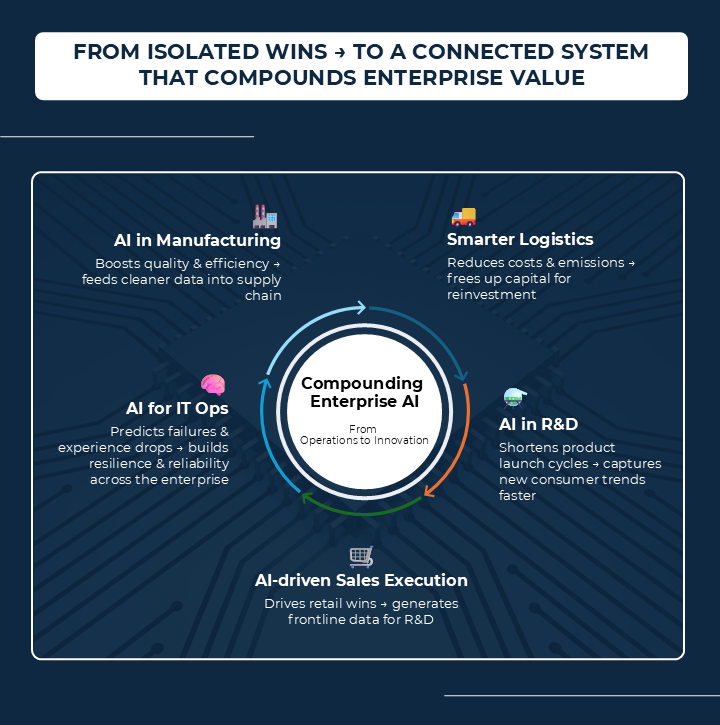
The Compounding Flywheel
When these initiatives connect, they create a flywheel:
Operations → Insights → Innovation → Consumer Experience → Operations
- Manufacturing AI feeds clean data to logistics.
- Smarter logistics optimizes delivery and frees capital.
- AI-driven sales generate insights that accelerate R&D.
- Faster R&D cycles enhance consumer experiences.
- IT ensures the flywheel spins continuously.
Each loop reinforces the others. The impact is exponential, not linear.
Small, isolated wins are stepping stones. Connected wins are a force multiplier.
The Take Away
- Think loops, not silos. AI is most powerful when it compounds across functions.
- Measure cross-functional impact. Track how one initiative influences operations, sales, and R&D.
- Design for compounding value. Align AI investments with the flywheel, not just short-term gains.
Ask yourself: Are you collecting sparks—or spinning a flywheel?
Companies that embrace the flywheel don’t just innovate, they accelerate growth, efficiency, and consumer delight simultaneously.